
History Food Channel
Pope Gelasius I and the Crêpe
When Faith, Hospitality and Gastronomy Meet
Few dishes are as simple, universal and evocative as the crêpe. A little flour, eggs, milk or water, a hot surface and a skillful hand are enough to create the thin golden disc that has become one of the most familiar symbols of French gastronomy. Yet behind this apparently modest food lies a fascinating mixture of Christian tradition, popular legend, agricultural symbolism and centuries-old superstition. One of the most charming stories surrounding the crêpe takes us all the way back to fifth-century Rome and to Pope Gelasius I.
A Pope in Fifth-Century Rome
Gelasius I occupied the throne of Saint Peter from 492 until his death in 496. His pontificate was short, lasting only about four years, but it came at an extraordinary moment in European history. The Western Roman Empire had collapsed only a few years earlier, in 476, and Rome was living through a period of profound political and social transformation.
In this uncertain world, the Church was gradually assuming an increasingly important role not only in spiritual affairs but also in the daily life of the population. Charity and hospitality towards strangers, the poor and pilgrims were considered fundamental Christian duties.
It is in this context that tradition places the unexpected encounter between Pope Gelasius and the ancestor of one of France’s most celebrated foods: the crêpe.
According to a legend that has been repeated for generations, numerous pilgrims came to Rome at the beginning of February to participate in religious celebrations. They had often travelled for days or weeks, sometimes on foot, enduring the cold and hardships of winter.
Gelasius, moved by their condition, is said to have ordered that they be fed.
The papal kitchens therefore needed something inexpensive, nourishing, simple and above all capable of being prepared rapidly for large numbers of people. Flour and eggs were mixed into a liquid batter and cooked in thin layers on hot surfaces. These primitive pancakes, according to the story, were distributed to the hungry pilgrims.
Thus was born the enduring legend of Pope Gelasius I and the crêpes.
It would be excessive to claim that Gelasius literally “invented” the crêpe as we know it today. Flat cakes made from cereals are far older than Christianity and existed in numerous ancient civilizations. The historical importance of the legend lies elsewhere: it connects a simple food with the Christian tradition of hospitality and with the feast that would become inseparable from crêpes in France — Candlemas, or La Chandeleur.
Candlemas: Light, Pilgrims and Golden Crêpes
Candlemas is celebrated on 2 February, forty days after Christmas, and commemorates the Presentation of Christ in the Temple. Its name evokes candles and therefore light.
Over the centuries, an extraordinary association developed between the religious feast and the golden crêpe.
Its shape offered an obvious symbolism. Round and golden, the crêpe resembled the sun. At the darkest point of winter, when people were beginning to notice the days becoming longer again, this edible “sun” became associated with the return of light and the promise of spring.
For rural communities, however, the symbolism went even further. Flour represented the harvest. Making crêpes at Candlemas was therefore connected with hopes for prosperity and abundant crops during the year ahead.
The crêpe consequently became much more than food. It was transformed into a small domestic ritual through which Christianity, the agricultural calendar and older popular customs could coexist around the same table.
The Crêpe and the Gold Coin
One of the most curious traditions associated with Candlemas concerns the moment when the crêpe is turned.
According to an old French custom, the cook should hold the frying pan in the right hand and a gold coin in the left. The crêpe must then be tossed into the air and caught perfectly in the pan.
If the operation succeeds, prosperity is supposed to accompany the household throughout the coming year.
In some versions of the tradition, the first crêpe was placed on top of a cupboard together with the coin and kept there for an entire year. It was believed that the family would consequently never lack money or food.
The custom may seem picturesque today, but it reveals how precious flour once was. In an agricultural society, wasting a crêpe by throwing it badly was not entirely insignificant. Successfully catching it became almost a symbolic demonstration that the household knew how to preserve the gifts of the harvest.
Even today, many French families still toss their crêpes into the air on 2 February, although coins — and fears for the year’s wheat harvest — have generally disappeared.
From Rome to France
The crêpe’s history did not stop with the legend of Gelasius.
Over the centuries it became particularly associated with Brittany, where another cereal transformed its identity: buckwheat. Introduced into European agriculture during the Middle Ages, buckwheat adapted remarkably well to the Breton climate and soil.
From it came the famous galette de sarrasin, traditionally prepared with buckwheat flour and water and generally served with savoury ingredients.
The wheat crêpe, by contrast, became associated particularly with sweet preparations. Butter, sugar, honey, preserves, chocolate, chestnut cream, apples, lemon and countless other ingredients eventually turned the simple pancake into an extraordinarily versatile dish.
The very word “crêpe” is generally associated with the Latin crispus, meaning curled or wavy — an allusion to the slightly rippled appearance that the thin batter acquires as it cooks.
And so a food that may once have been valued principally because it was economical and nourishing gradually entered the sophisticated repertoire of French cuisine.
The Accidental Crêpe Suzette
Among all the stories associated with crêpes, none is more glamorous than that of Crêpes Suzette.
The celebrated dessert consists of crêpes served with a sauce traditionally involving butter, sugar, citrus — especially orange — and liqueur. Its origins are disputed, and several versions of the story exist.
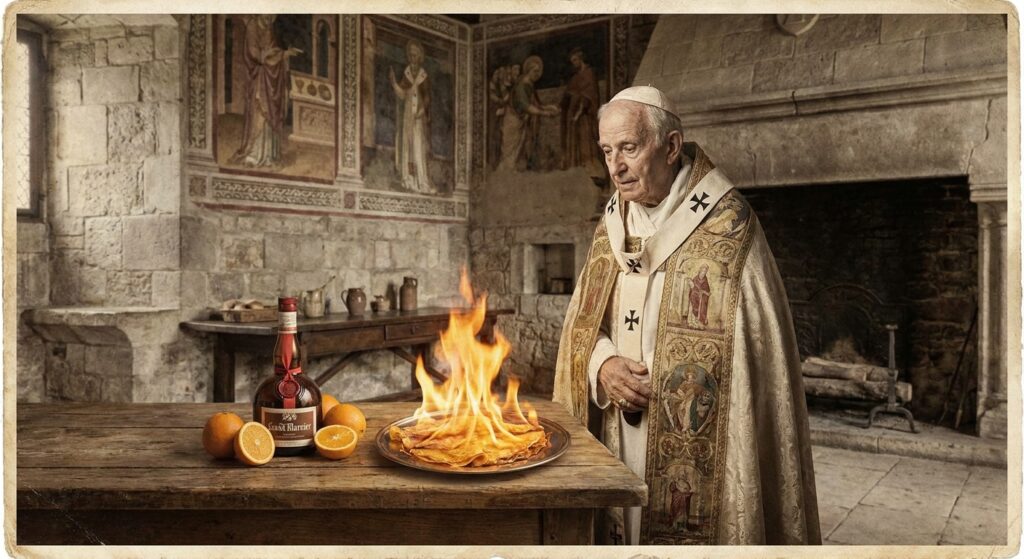
The most famous legend places its creation at the end of the nineteenth century and involves the future King Edward VII of Britain, then Prince of Wales. According to the tale, a young waiter preparing crêpes with orange liqueur accidentally allowed the alcohol to catch fire. Rather than ruining the dish, the flames concentrated the aromas and created something unexpectedly delicious.
The prince supposedly enjoyed the result and asked that the dessert be named after a young woman at the table: Suzette.
Whether the story happened exactly this way is uncertain. But that uncertainty is almost part of its charm. Like Gelasius and the pilgrims, Crêpes Suzette belong to that delightful territory where culinary history and storytelling overlap.
A Dish That Crosses Social Boundaries
Perhaps the most remarkable characteristic of the crêpe is its ability to belong simultaneously to very different worlds.
It can be street food, eaten warm from a folded piece of paper. It can be a child’s afternoon snack sprinkled simply with sugar. It can be a rustic Breton meal accompanied by cider. And it can become an elegant restaurant dessert, flambéed dramatically before the guests.
Few foods have travelled so easily between poverty and luxury.
That quality makes the legend of Pope Gelasius particularly appropriate. The supposed origin of the tradition is not a royal banquet or an aristocratic kitchen. It is an act of hospitality: hungry travellers arriving in Rome and being given a warm, simple meal.
The crêpe required no rare spices, expensive meat or elaborate equipment. Its value came precisely from its simplicity.
A Small Sun on the Table
More than fifteen centuries separate us from Pope Gelasius I. We cannot know whether the pilgrims of fifth-century Rome really received something that we would recognize today as crêpes. History advises caution, while tradition invites imagination.
But legends often survive because they express something deeper than literal fact.
The story of Gelasius and the pilgrims associates food with generosity. Candlemas associates it with light. Agricultural traditions associate it with abundance. The gold coin associates it with prosperity. And the simple gesture of tossing a crêpe into the air transforms cooking into celebration.
Perhaps that explains why the crêpe has survived so successfully through the centuries.
Made from the humblest ingredients, it can carry an extraordinary amount of symbolism. It speaks of winter giving way to spring, darkness giving way to light and flour from one harvest becoming hope for the next.
And somewhere behind the golden crêpe of Candlemas remains the appealing image of fifth-century Rome: weary pilgrims arriving after a long journey, fires burning in the kitchens, flour and eggs being mixed in great quantities, and a pope ordering that the travellers should be fed.
Whether history or legend, it is a beautiful beginning for one of Europe’s most beloved culinary traditions.